
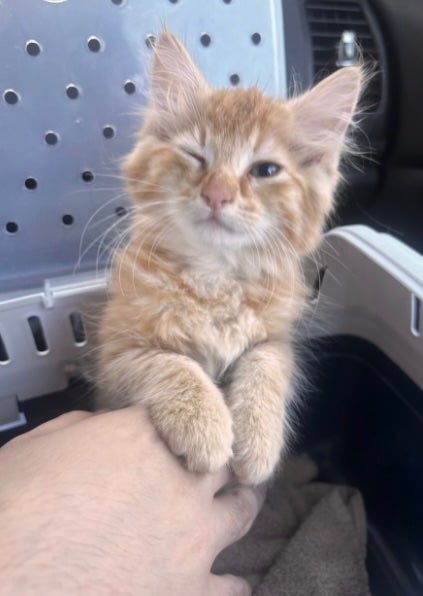
 Meet Sushi! He is an adorable orange kitten who was found outside by his new owners. When he was found, he had fleas around his body, some gunk in his ears, and he was having soft stools. As soon as they brought him home, his owners called us to schedule his first veterinary visit. Sushi was thrilled to come and enjoy Squeeze-Up treats during his exam. Weighing in at just 1.9 pounds, we estimated that Sushi was approximately 8 weeks old at the time.
Kittens and puppies commonly acquire intestinal parasites while nursing from their mothers. Since Sushi was found as a stray and likely had not been dewormed, intestinal parasites, along with an inconsistent diet, were the most probable causes of his diarrhea. We started Sushi on a deworming protocol targeting hookworms and roundworms while awaiting a stool sample to screen for any additional parasites.
Ideally, kittens should receive their first deworming at 3 weeks of age and continue treatment every two weeks until they are 8-10 weeks old, which should then be followed by a monthly dewormer. We recommend checking a stool sample to monitor the presence of intestinal parasites, which is complimentary with each kitten wellness visit.
We're happy to report that Sushi's stool sample was negative, which is great! It was also important to address Sushi's flea infestation. Fleas can carry diseases that may make kittens sick. In addition, a heavy flea burden can cause anemia (a low red blood cell count) in tiny kittens like him. Sushi was sent home with a complimentary sample of Nexgard® Combo, which not only treats fleas and ticks but also targets tapeworms, roundworms, and hookworms, while providing prevention against heartworm disease.
Heartworms are spread through mosquitoes and can cause life-threatening respiratory disease in cats. Even though Sushi will likely spend most of his future indoors, mosquitoes can still make their way into our homes, placing even indoor cats at risk for heartworms. For this reason, we recommended that Sushi continue monthly heartworm prevention to protect him from internal and external parasites.
Once Sushi's immediate concerns were addressed, we switched our focus to preventative care. Whenever a new cat is adopted, we recommend performing a blood test to screen for Feline Leukemia Virus (FeLV) and Feline Immunodeficiency Virus (FIV). If a kitten tests positive for FeLV, we will not administer the FeLV vaccine and instead concentrate on other preventative and supportive care.
FeLV is spread through contact with the bodily fluids of an infected cat, such as saliva, nasal secretions, urine, and feces. Kittens can become infected from their mother before birth, through nursing, or later through sharing food bowls, grooming, mating, or bite wounds from other infected cats. If a kitten tests negative, we recommend vaccinating for FeLV during the first two years of life, since this is when cats are most susceptible. After two years of age, if a cat's lifestyle places them at higher risk, such as outdoor access, living with indoor/outdoor cats, or in households that foster, then we recommend continuing the FeLV vaccine every two years.
FIV is mainly spread through bite wounds from other infected cats, and unfortunately, there is currently no effective vaccine available. However, knowing a cat's FIV status is important so appropriate precautions can be taken to keep them healthy. Cats who are FIV-positive should also be kept separately from FIV-negative cats to prevent the spread of the virus.
Kittens are also vaccinated with the FvRCP vaccine, which protects against several common respiratory and gastrointestinal viruses. To ensure full protection, this vaccine must be boosted every three weeks until kittens are at least 16 weeks old. At 12 weeks of age, kittens are also old enough to receive their Rabies vaccine.
We are very happy to share that Sushi was negative for FeLV and FIV. He completed his vaccine series, had his ears cleaned, and received a topical preventative as well as an oral dewormer to help rid himself of internal and external parasites. He is now living life as a beautiful, fluffy kitten. Sushi was lucky to be found and now has a family ready to give him a life full of care that he needs!